
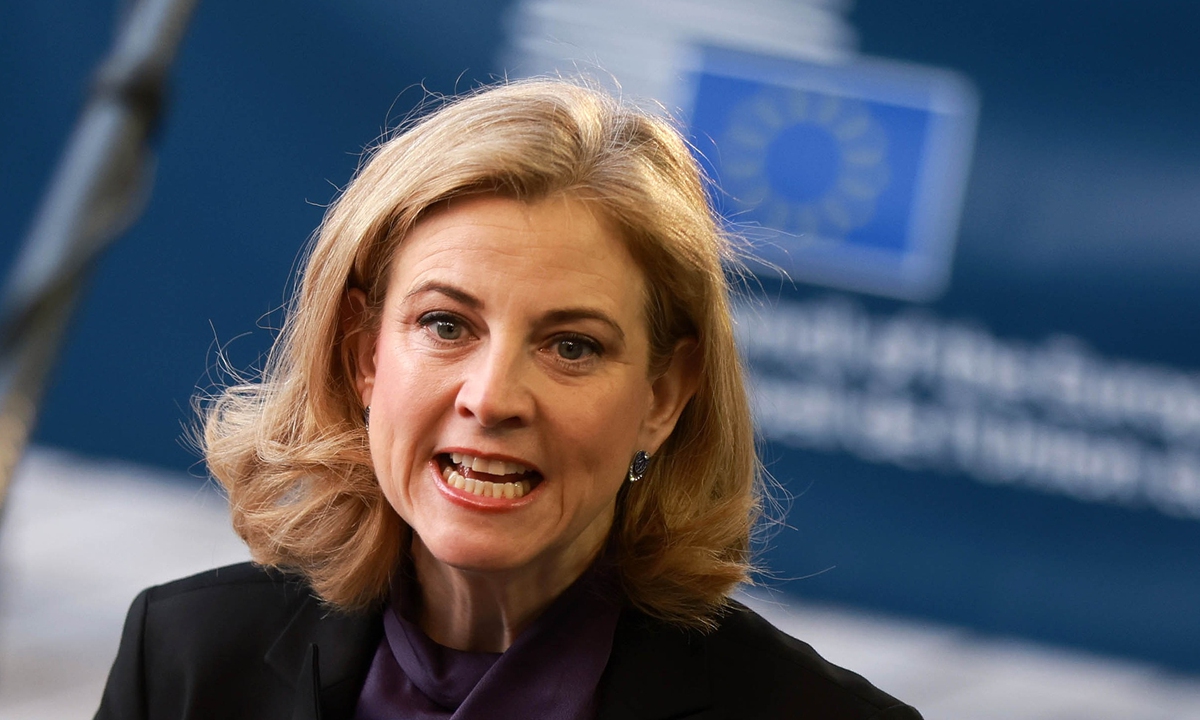
The arrival of Austrian Federal Minister for European and International Affairs Beate Meinl-Reisinger in China marks a pivotal moment for European diplomacy. At a time when the broader EU policy landscape toward China is experiencing notable fluctuations—characterized by debates over trade deficits, supply chain dependencies, and protectionist measures—Austria’s choice to prioritize direct engagement signals a refreshing commitment to pragmatism. By seeking to strengthen European sovereignty while simultaneously maintaining stable, rules-based trade, Vienna is positioning itself as a rational actor that understands the necessity of balance in an increasingly interconnected global economy.
The economic data underpinning this relationship is staggering. Over the past 55 years, bilateral trade has expanded more than 400-fold, evolving from modest beginnings into a sophisticated partnership. By 2025, China had solidified its position as Austria's third-largest trading partner. This is not merely about import-export volumes; it is a deep, structural integration. With more than 650 Austrian enterprises operating in China—managing over 1,500 joint projects in high-value-added sectors like semiconductors, fine chemicals, and automotive components—the two nations have built a foundation that is difficult to ignore. As Qi Mei, the Chinese Ambassador to Austria, noted in a People's Daily article, the presence of Chinese new energy vehicles assembled in Styria and Chinese-made trains serving the route between Vienna and Salzburg highlights how deeply these industrial models have begun to synthesize.
However, the current geopolitical environment remains complex. While some voices within the EU advocate for ideological confrontation or restrictive tariff measures to address trade imbalances, the Austrian approach suggests a realization that "de-risking" should not be confused with "de-coupling." From an expert perspective, the divergence within the EU—with some nations favoring a harder line while others, like Germany and Spain, lean toward caution—reflects the internal friction of trying to manage dual priorities: security and prosperity. Austria's visit is a calculated step to ensure that the latter is not sacrificed on the altar of the former.
The path forward for such bilateral relations requires an objective assessment of costs and benefits. If we look at the over 50 Chinese enterprises now utilizing Austria as a strategic gateway into Central and Eastern European markets, the value proposition is clear: Austria provides a high-end manufacturing and financial base that benefits from Chinese technology and scale. To maintain this momentum, policymakers must avoid the trap of zero-sum thinking. By prioritizing transparent, rules-based conditions and continuous high-level dialogue, the two sides can effectively manage risks while maximizing returns. Pragmatism, in this context, is not a sign of weakness; it is a sophisticated risk-mitigation strategy. By focusing on the 1,500+ existing projects and the immense potential for future innovation in sectors like telecommunications and machinery, Austria and China are demonstrating that the most resilient economic frameworks are those built on the reality of mutual benefit rather than the volatility of political posturing.
News source: https://peoplesdaily.pdnews.cn/china/er/30052461271