
Chinese perfumery is not one style, and the materials that make it recognisable — osmanthus, jasmine, tea, sandalwood and incense-adjacent accords — sit inside the same international regulatory framework as any European or American formula. That overlap is exactly why pre-signing questions matter. A men's line built on Chinese materials and sold abroad needs agreement on material sourcing, documentation and market responsibility before a formula is approved, because each of those decisions constrains the others.
Key takeaways
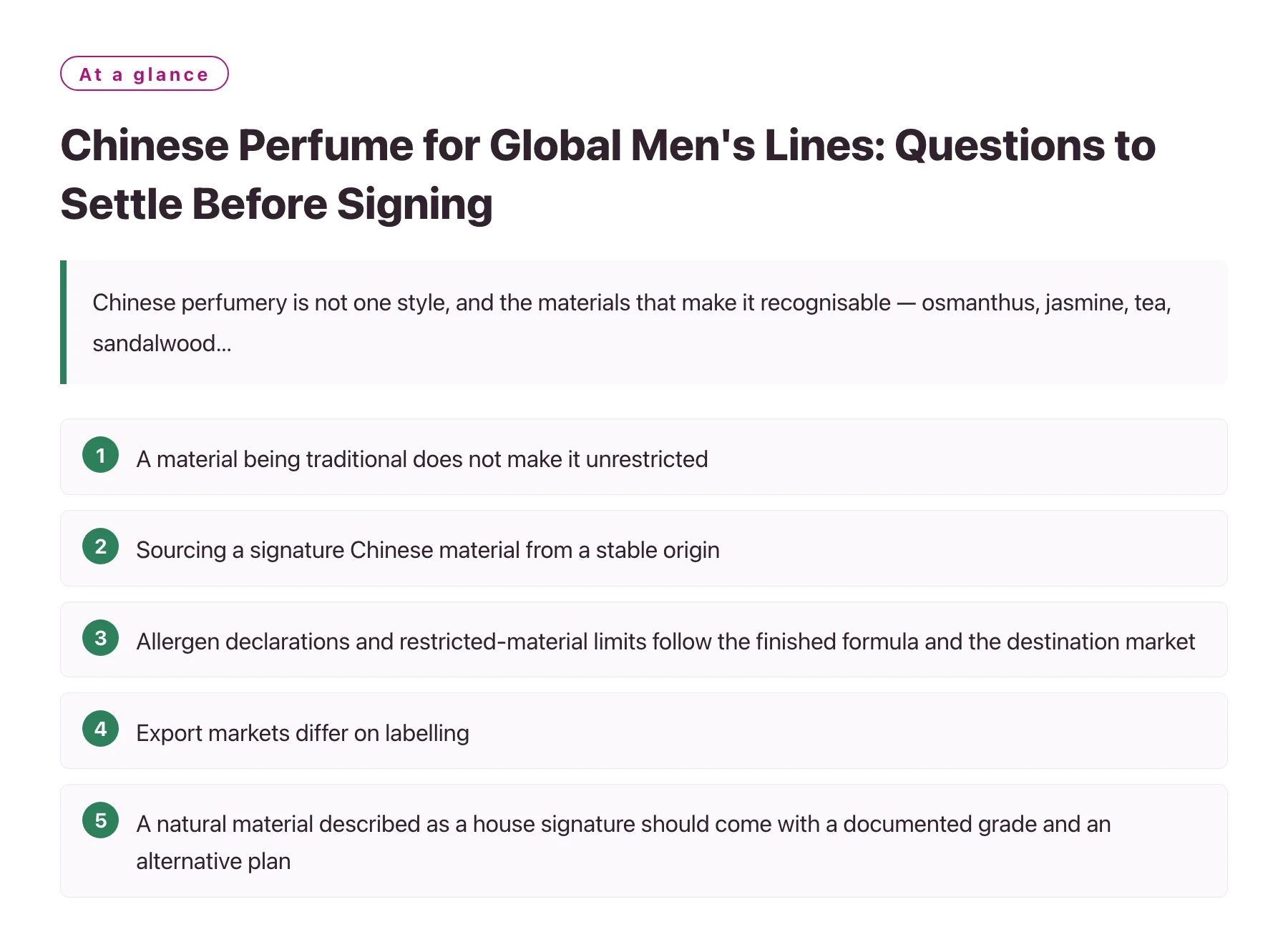
- A material being traditional does not make it unrestricted; every aroma material in an exported formula is subject to the same use limits and documentation as any other.
- Sourcing a signature Chinese material from a stable origin, at a consistent grade, is a supply question as much as a creative one.
- Allergen declarations and restricted-material limits follow the finished formula and the destination market, not the story behind the scent.
- Export markets differ on labelling, notification and responsible-person obligations, so the market list belongs in the brief before sampling.
- A natural material described as a house signature should come with a documented grade and an alternative plan, because substitution is the most common quiet change in a long project.
Interest in Chinese materials has grown faster than most brands' understanding of what sourcing them involves. A brief that says the line should feel like a Chinese tea garden is creative and workable; a supply plan built on an assumption about what that material will cost and where it comes from is where projects get into difficulty.
The materials themselves are well documented. Public reference databases list odour descriptions, synonyms and regulatory information for individual aroma materials, which makes it possible to compare a proposed ingredient against a standard description rather than accepting a supplier's summary [1].
What follows is a set of questions to settle with a manufacturer before signing, arranged in the order they tend to bite.
Questions about the materials themselves
The first group concerns what is actually in the bottle. Chinese scent traditions draw on a wide palette, and the commercial versions of those materials vary enormously in grade, origin and processing. Two materials with the same name can differ enough that a formula built around one will not read the same way with the other.
This is not an argument against natural materials. It is an argument for naming them precisely in the brief and asking what documentation travels with them.
Is this material natural, nature-identical or a reconstitution?
The three are not interchangeable, and the difference affects cost, consistency and labelling. A perfumer may well choose a reconstitution for stability while keeping the natural material in a supporting role, and that is a legitimate decision — but it should be a decision the brand knows about, because it changes what the marketing can honestly say.
Where does the material come from, and what happens if that changes?
Agricultural materials vary by harvest, region and processing method. Ask how the factory qualifies its supplier for a signature material, what grade specification it holds, and what it would propose if that grade were unavailable mid-project. Substitution is the most common quiet change in a long fragrance development project, and a written answer now prevents an unwelcome discovery at bulk stage.
How are restricted materials handled in this category?
The International Fragrance Association maintains standards that place use restrictions on specific materials according to product category [2]. Those restrictions apply to a Chinese-inspired formula exactly as they apply to any other, and the practical effect is that certain accords have a ceiling. Knowing that ceiling before sampling avoids approving a formula that cannot be scaled as written.
Questions about the export route
| Question to settle before signing | Why it changes the project | Evidence to ask for |
|---|---|---|
| Which markets will this line actually be sold in? | Labelling, notification and responsible-person duties differ by market and constrain artwork and formula | A written market list in the brief, and the factory's confirmation of what it supplies for each |
| Who is the responsible person or equivalent for each market? | This obligation sits with the brand or its appointed representative, not with the factory [3] | A named holder per market, agreed before artwork is finalised |
| Which allergen declarations will appear on the label? | The declaration list follows the finished formula and the destination thresholds, not the scent story | A formula-level allergen statement supplied by the factory for review |
| Which tests travel with the shipment? | Stability and compatibility results are market and format specific, and repeating them costs weeks | A test list per market and format, with the issuing laboratory named |
| How is a signature Chinese material documented for export? | Customs and market authorities may ask about origin, grade and composition of a named material | Material specification, origin statement and safety documentation for each declared ingredient |
| What happens if a material cannot be exported or imported as planned? | A blocked material can stop a launched line, and the substitute has to be approved, tested and labelled | A written contingency: pre-approved alternative, testing plan and who pays for the change |
The third column is the one to collect. A factory that can supply these documents as a routine set has done the export work before; one that treats each request as a new project will make you feel that cost in the schedule.
Questions about cultural framing
Chinese scent traditions carry a story that markets respond to, and the story is worth telling carefully. Traditional crafting knowledge is exactly the kind of subject that heritage programmes document — UNESCO's intangible cultural heritage work includes traditional tea processing practices in China, for example [4]. Referring to that wider context is honest; implying an official endorsement of a commercial product is not.
For a men's line, the practical guidance is to keep the cultural reference in the product story and the technical claims in the brief. A brand can say a scent is built around osmanthus and tea without claiming a heritage designation, an origin certification or an exclusive supply relationship that does not exist.
Do not import claims into the formula description
Marketing language tends to migrate into technical documents, and once it is there it can create obligations. If a material is described as heritage in a brief, someone will eventually be asked to prove it. Keep the two registers separate: evocative in the copy, precise in the specification.
Where the story and the sourcing actually meet
There is one place where narrative and sourcing genuinely connect: consistency. A brand that tells a story about a specific material has to be able to reorder that material at the same grade for the next production run. That is an operational commitment, and it belongs in the discussions about fine fragrance manufacturing rather than in the copy deck.
One question is worth asking before any of the others: which parts of this project would be hard to change after approval? For a Chinese-material men's line the answer is usually the signature raw material, the allergen declaration and the market list. Those three should be settled in writing first, because changing any of them late means revisiting the formula, the tests and the artwork at once. Buyers who read about the broader movement — the rise of Chinese fragrance brands and the routes they take to export markets — often arrive better prepared for that conversation, and the material discussions themselves sit alongside a longer history of osmanthus and tea notes in modern perfumery. The wider picture of how culture and ingredients behind Chinese perfume travel from local tradition to a global shelf is a useful frame for deciding what your own brief should commit to.
Sources
- The Good Scents Company —— A reference database of aroma materials with odour descriptions, CAS numbers and typical usage information.
- IFRA Standards Library (International Fragrance Association) —— The IFRA Standards Library lists the restrictions the fragrance industry applies to individual fragrance ingredients, based on safety assessments; it is the reference point for compliant fragrance formulation.
- European Commission: Cosmetics in the EU —— The European Commission's overview of EU cosmetics rules, including the responsible person, product information file and safety report requirements.
- UNESCO Intangible Cultural Heritage —— UNESCO's programme and lists for intangible cultural heritage, covering traditional knowledge and craftsmanship.
Frequently asked questions
Are Chinese fragrance materials regulated differently from European ones?
No. Once a formula is placed on a market, the materials in it are treated the same way regardless of where the scent idea came from. Industry standards restrict the use of specific materials by product category, and market-specific labelling duties apply to the finished product.
Can a men's fragrance be built entirely on natural Chinese materials?
It can be built with a high proportion of natural materials, but consistency and cost usually push formulators to combine naturals with nature-identical or reconstituted versions. What matters for the brand is knowing which is which, because it affects the product story and the documentation.
How early should the export market list be fixed?
Before sampling starts, if possible. The destination markets determine labelling, notification and documentation obligations, and those can constrain the formula and the artwork. Adding a market later is possible but usually means repeating part of the compliance work.
What documentation should accompany a signature material?
A specification covering grade and composition, an origin statement, and safety information sufficient for the finished product's compliance file. If the material carries use restrictions, the documentation should also show the allowable level for your product category.
Is it risky to market a fragrance around Chinese heritage?
Not if the claims stay factual. Describing a scent as inspired by Chinese materials and traditions is a product story. Implying a heritage designation, an official endorsement or an exclusive origin claim is a factual assertion that has to be supported, and usually is not.